Respite Care in Palm Bay, FL: Short-Term Support for Family Caregivers
A clear look at respite options, Palm Bay cost benchmarks, Florida coverage rules, and practical steps for a first short stay.
Caring for a spouse or parent can become a continuous responsibility, even when caregiving is shared willingly. For families researching respite care in Palm Bay FL, the useful questions are practical: what kind of help is available, how a short break might be funded, and what a loved one needs before the first stay. Local cost benchmarks can guide a budget, but they do not replace a provider's written quote.
A planned break can make room for rest, medical appointments, travel, work, or simply uninterrupted sleep. It can also give everyone a chance to test a care arrangement before making a longer-term decision. Respite is flexible: it may last part of a day, cover several days at home, or involve a temporary residential stay.
What respite care in Palm Bay FL actually means
The National Institute on Aging's overview of respite care defines it as short-term relief for a primary caregiver. That relief can happen in the person's home, at an adult day center, or during a short stay in a residential setting. The defining feature is temporary support for the caregiver and the person receiving care, not a commitment to a permanent move.
A useful plan begins with the reason for the break. A spouse who needs two quiet afternoons may prefer help at home, while a family caregiver leaving Brevard County for several days may need overnight supervision. Consider the person's mobility, memory, personal-care needs, routines, and tolerance for unfamiliar places. For someone living with dementia, ask how a provider supplies supervision, daily support, and a calm environment; respite should not be presented as a treatment or a promise of improvement.
Three settings for a short break
Each setting solves a different logistical problem. Consider who will handle personal care, meals, transportation, and overnight needs rather than choosing by setting alone.
- In-home respite: A caregiver comes to the person's home. This can preserve familiar surroundings, but families should ask about minimum hours, the tasks included, schedule changes, and who provides backup if the caregiver cannot arrive.
- Adult day care: The person spends part of the day at a center. Ask about opening hours, transportation, meals, personal-care assistance, health-related services, and whether occasional attendance is possible.
- Short residential stays: The person stays temporarily in a residential care setting. Clarify the arrival and departure dates, overnight supervision, medication procedures, and what happens if care needs change during the stay.
The the National Institute on Aging notes that respite can give caregivers time to rest or attend to other needs and encourages planning ahead. Its guidance on respite care is also a useful starting point for discussing dementia-related routines. Whichever setting you consider, write down who is responsible for each task; respite alone does not describe a service package.
Palm Bay cost benchmarks for a respite budget
The , based on data collected from July through November 2025, offers local reference points. They describe a market, not a quote from Home At Last Of Brevard or any other individual provider.
Adult day health care can be a practical way to purchase daytime relief without arranging an overnight stay. The daily figure helps frame occasional use; the monthly figure reflects the survey's monthly cost category. Neither amount reveals a particular center's attendance requirements. Before budgeting, ask about enrollment, assessments, minimum days, transportation, and which services are included.
The in-home figures show why the number of hours matters. List the hours when you truly need another person present, then ask agencies about hourly minimums and weekend or holiday terms. A short residential stay requires its own quote.
Comparing ongoing care with a short residential stay
These categories provide different services and are not direct substitutes.
The assisted living median is not a short-stay respite rate. A temporary admission may be quoted differently and may have different included services. Request the dates, daily or total charge, care included, and any possible additional fees in writing. Families considering Home At Last Of Brevard should call for current respite rates and availability rather than applying a survey median to the cottage.
Florida Medicaid, Medicare and insurance
Florida's Statewide Medicaid Managed Care Long-Term Care program can cover respite, adult day care, personal care, and assisted living services. Eligibility is limited to Medicaid-eligible people who are 65 or older, or 18 or older with a disability, and who need a nursing facility level of care. Enrollment is limited and there is a waitlist, so a diagnosis or an immediate caregiving crisis does not by itself establish eligibility.
Screening begins through the local Aging and Disability Resource Center, using the Elder Helpline. Ask what services may be authorized, how the waitlist works, which providers are available in Palm Bay, and what costs remain the family's responsibility. Do not assume that approval for one service automatically approves a residential short stay.
Medicare's explanation of long-term care coverage states that Medicare does not cover long-term custodial care when that is the only care needed, and most long-term care is custodial. Families should therefore not assume that Medicare will pay for a residential respite stay. Long-term care insurance may help, depending on the policy. Benefits commonly depend on an elimination period and on needs involving daily activities or cognitive impairment. Ask the insurer specifically about respite, approved settings, documentation, and reimbursement.
How to prepare for a first short stay
A written handoff reduces uncertainty for the person receiving care and for the temporary caregiver. Keep it factual, concise, and easy to update.
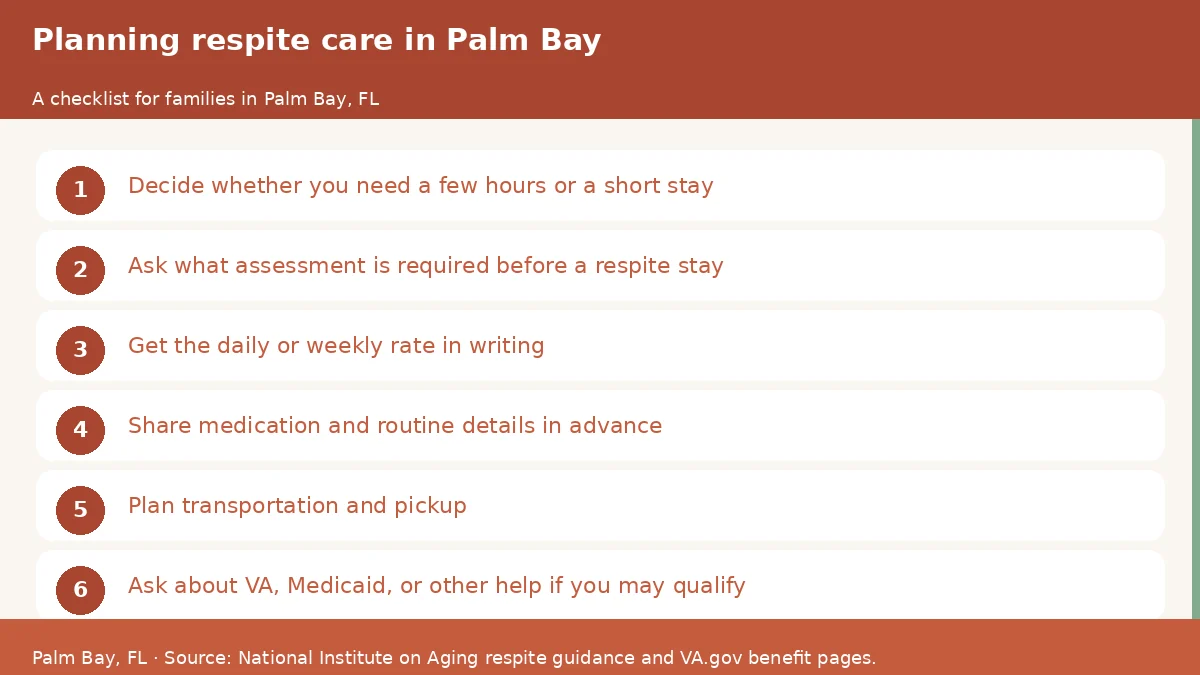
- Describe an ordinary day. Include waking and bedtime, food preferences, mobility, toileting, bathing, communication, and activities that are familiar or comforting. Note what help is actually needed rather than writing only a diagnosis.
- Organize health information. Prepare the medication list with doses and times, allergies, prescribers, pharmacy details, and recent health changes. Confirm how the provider wants medications supplied and who should be contacted about a change.
- Set up contacts and documents. Identify one primary family contact, an alternate, and emergency contacts. Ask whether the provider needs identification, insurance information, physician orders, or copies of advance directives if they exist.
- Pack for recognition and comfort. Label clothing and personal items, and include needed glasses, hearing aids, and mobility equipment. A few familiar objects may help the room feel less unfamiliar; ask about space and laundry before packing.
- Clarify the stay itself. Record arrival and pickup times, transportation, payment terms, and the planned end date. Agree on how updates will be shared and how everyone will review whether the arrangement worked.
Whenever possible, arrange a visit before the stay. Use it to observe entrances, common spaces, noise, and how staff communicate, without assuming that a brief tour answers every question. Introduce the plan honestly to your loved one in language they can understand, and avoid presenting a temporary stay as something else.
Choosing a local respite setting
Location can affect whether respite care in Palm Bay FL is easy to use. Home At Last Of Brevard is a small cottage-style home at 380 Englar Ave NE in northeast Palm Bay, in southern Brevard County. It offers assisted living, memory care, and respite care. Families traveling from Malabar Road, West Melbourne, Melbourne, or Interstate 95 should check the route and allow time for an unhurried handoff.
Ask how a short stay would work for your particular situation: what the quoted rate includes, whether a minimum stay applies, how care needs are assessed, who is present overnight, and how families receive updates. If memory care is needed, ask about supervision, daily support, and the environment rather than expecting a change in the underlying condition.
The Florida Agency for Health Care Administration licenses assisted living facilities under state law and describes specialty licenses for Extended Congregate Care, Limited Nursing Services, and Limited Mental Health. Florida also requires Alzheimer's and dementia training for staff in facilities that advertise memory care. Ask which license applies to any provider you are considering and how its required training is maintained; do not infer a license or service level from the word cottage.
A workable respite plan ends with more than a date on a calendar. It leaves the caregiver knowing who will provide each service, the loved one arriving with familiar routines clearly explained, and the family understanding the cost and backup plan. That preparation makes the break easier to evaluate and easier to repeat if it fits.
Frequently asked questions
What is respite care in Palm Bay, FL?
Respite care is temporary support that gives a family caregiver a break while another person or setting assists their loved one. In Palm Bay, it can be arranged at home, through an adult day program, or as a short stay in a residential care setting. The best fit depends on whether help is needed for a few daytime hours, overnight supervision, personal care, or several days away. It does not require a permanent move.
How can I estimate a respite care budget in Palm Bay?
These are survey reference points, not prices for one provider or for a residential short stay. Ask each provider about minimum hours or days, included services, assessments, and a written quote for your exact dates.
Does Florida Medicaid cover respite care for Palm Bay residents?
Florida's Statewide Medicaid Managed Care Long-Term Care program can cover respite for eligible people, along with services such as personal care, adult day care, and assisted living services. Applicants must meet Medicaid requirements, be 65 or older or be 18 or older with a disability, and need a nursing facility level of care. Enrollment is limited and a waitlist applies. Palm Bay families can begin screening through the local Aging and Disability Resource Center; coverage should not be assumed.
What should we prepare for a loved one's first respite stay?
Bring labeled clothing and any glasses, hearing aids, or mobility equipment your loved one uses. Prepare a current medication list, allergy information, prescriber and pharmacy contacts, emergency contacts, and a short description of daily routines, food preferences, mobility, and communication needs. Ask Home At Last Of Brevard or any provider what documents and medication packaging it requires. Confirm arrival, pickup, payment terms, the end date, and how family updates will be handled.
Does Home At Last Of Brevard offer short-term respite care?
Home At Last Of Brevard offers respite care, as well as assisted living and memory care, at its small cottage-style home at 380 Englar Ave NE in Palm Bay. Because survey medians are not the home's prices, call for current respite rates, available dates, and any minimum-stay or assessment requirements. Ask what the quote includes and how overnight supervision, personal care, medication procedures, and family communication would be handled during the specific stay you are planning.
Talk with Home At Last Of Brevard
If you are weighing care options in Palm Bay, call (321) 327-3573 or visit. Our team can talk through current availability, rates and next steps. Please confirm all details directly, since published figures and listings change over time.
Sources
- Medicare: long-term care coverage
- National Institute on Aging: What is respite care?
- the National Institute on Aging: respite care
- ACL: What is long-term care insurance
- Florida AHCA: Assisted Living Unit
- Florida AHCA: Statewide Medicaid Managed Care Long-Term Care Program
Program rules and benefit amounts were checked on the linked official pages in November 2026 and can change.
Related reading on this site: